
“Do you hear that?” I ask as my eyes flit toward the bedroom window.
“No,” comes the sleepy answer from my wife, who doesn’t hear much once her hearing aids are removed for the night.
I rise from the bed, expecting that I won’t see anything in the nighttime darkness.
I hear yips and howls as my eyes search in vain for a glimpse of the elusive creatures that wander through our six acres of Connecticut woods.
“They must be up at the farm,” I murmur, as much to myself as to Barb, who has already slipped back to sleep. I slide between the covers, vowing that someday I’ll see them. After all, we have seen coyote tracks in the winter snow. Many tracks, crisscrossing a small frozen stream behind our home.
I fall asleep listening to the pack adults teaching their offspring the vocalizations of primal communication.
“Someday I’ll see you” I whisper as I close my eyes.
Now, it’s late summer and we are in Custer, South Dakota. We’re driving to the town of Hot Springs excited to visit Mammoth Site, an active excavation site of wooly mammoth remains. On the way there, open land stretches out on both sides of the road. As far as we can see, the prairie grass waves in the wind. Short hills rise and fall, blending with areas of flat land between. The flats are dotted with dark circles of exposed earth, in small mounds encircling prairie dog holes.
We see some of the small, cute, tan creatures standing, as if sentries, while others scurry and feed on slim blades of prairie grass. High pitched chirping sounds fill the air.
We decide to pull our car over to the side of the road to watch for a while. I settle on the front passenger seat, door open, with a small point-and-shoot camera in hand. I keep binoculars on the seat beside me. Barb, my wife, jumps out of the car reaching for her Canon R7 slr camera with a 100-500 mm lens. She won’t miss a thing! She leans on the rear of our car, steadying herself to start snapping.
The prairie dogs seem oblivious to our presence. Barb is getting great close ups of singles and pairs of prairie dogs interacting. Meanwhile I’m scanning the whole area, back and forth.
That’s when I see movement to the south. Four legged movement coming over a hill. Holy cow, it’s a coyote! Its tan coat blends in with the terrain, only its movement gives it away.
I get Barb’s attention with frantic arm waving in the coyote’s direction. We watch it approach one dark mound. It freezes. Its eyes seem to be fixed on the hole. We can only speculate, is it waiting for a prairie dog to emerge from that dark recess, his hope of dinner?
Fifteen minutes pass. It hasn’t moved. Surprisingly, other prairie dogs nearby, after initially skittering to their holes, emerge and chirp their warnings.
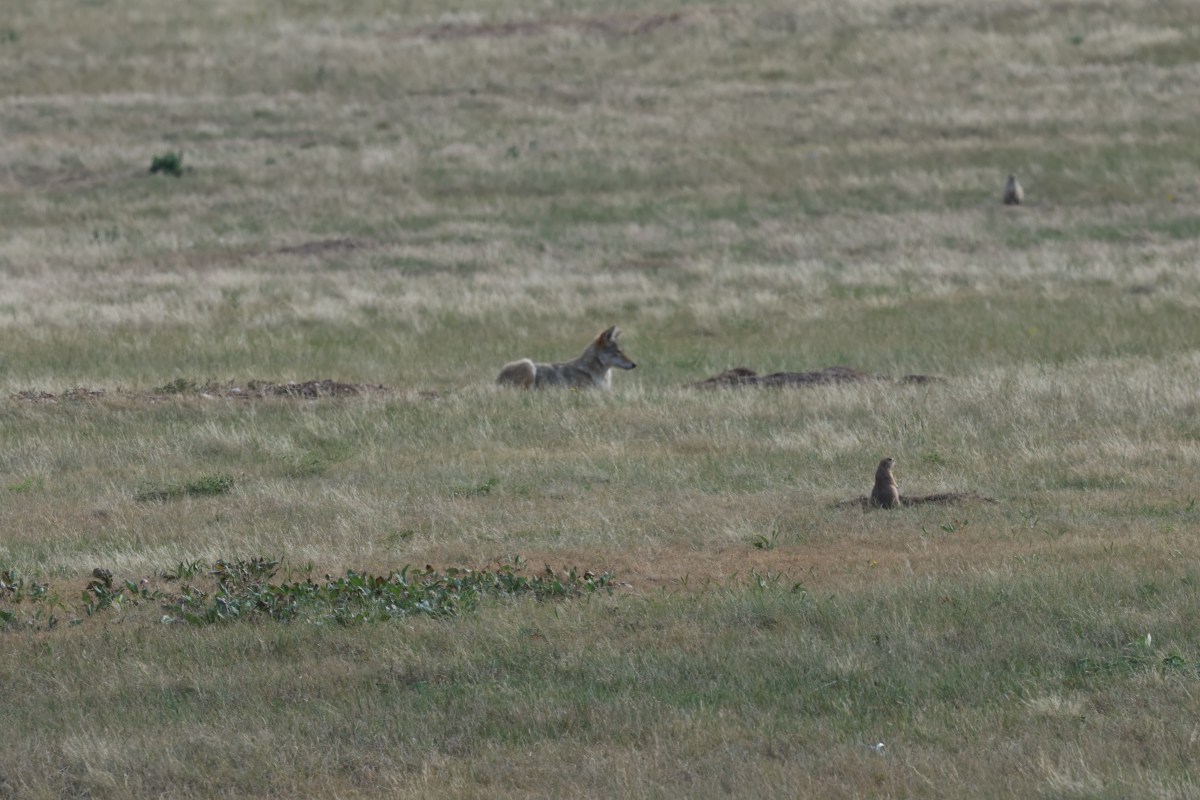
We are captivated by this scene, anticipating what might happen. Finally, and to our surprise, the coyote drops to the ground in the same spot.
What the heck? It is sitting like a dog at rest.
“What is it doing?” Barb whispers. I can only shrug my shoulders.
Fifteen more minutes pass. I have the coyote sighted in my binoculars and Barb watches through her big lens. Cars pass by. No one stops. I’m sure the occupants of those vehicles have no idea that there’s a coyote out there. Its sandy coat and low profile are the perfect camouflage for concealing its presence. Except for the prairie dogs, whose chirps punctuate the air, it’s our own private show.
As we wonder aloud how long the coyote will stay there, it rises. With a last look toward the unproductive hole, it trots over a nearby rise and disappears.
We’ve been watching and waiting, watching and waiting. Now this anticlimax. We both sigh, and yet acknowledge that we’ve seen a coyote in the wild!
As we start to pack our cameras, Barb grabs my arm. I follow her eyes to a coyote on the top of the rise across the road. While she is focused there, another one is much closer, actually crossing the road right in front of our car. I am so excited to see it, it’s all I can do to lift my Iphone and hit the video button.
The creature right in front of us ignores the prairie dog holes, moving quickly until it is out of sight. The one across the road is nowhere to be seen by the time we turn back to look for it.
Still, we high five each other. We are grinning like children opening Christmas presents. We have seen three coyotes today.
Satisfied and having spent well over an hour at this spot, I suggest, “It’s time we get moving to the Mammoth Site. There’s more to see today.”
We spend close to three hours at the excavation site, acquiring new knowledge about mammoths and how the bones of almost sixty of them ended up in this one place. It’s a very impressive site.
Heading back to the town where we are camped, we, of course, want to go by what we consider ‘our prairie dog area’ again. Before we get that far, I see five coyotes in a loose pack about a hundred yards from the road. Barb slows the car. I see the group break up, three going north and two heading west.
Now, I’m giddy. Five coyotes! They speed out of sight so fast that we don’t stop.
Ten minutes later we are back by the prairie dog holes again. It is pretty quiet. Is it siesta time in prairie dog town? We are content to sit and watch. We’ve learned the value of patience when looking for animals. I raise my binoculars and scan from hole to hole. Ten minutes pass. Fifteen.
Wait, over the rise to the south, heading north toward us, trot three coyotes. I pose a question to Barb. “Could it be the three that had split from the pack of five we just saw?”
Almost faster than we can follow, two of the coyotes scare up a rabbit. It zigs and zags frantically avoiding the canine jaws. Then all motion freezes as the bunny dodges into a prairie dog home. The two bewildered pursuers circle the hole. We watch in amazement. I had assumed coyotes feasted on these little helpless creatures having an easy time of the hunt. What we saw proved that theory to be all wrong. It looks like difficult, frustrating work!
The third coyote, who isn’t participating in the hunt, settles down a short distance away, like a domestic dog at rest. The two hunters keep moving from hole to hole with no better luck. They turn south and are gone down a dip in the terrain. We lose sight of them.
Our interest turns to the remaining coyote. It appears to be content to rest in the prairie grass, the wind caressing its face. Realizing we have seen all the action we are going to witness, we retreat to our Toyota.
I am feeling elated at this day’s developments.
We have seen multiple coyotes in their natural environment and observed them hunting prey. All up close. It was like viewing a National Geographic nature show, only we were there experiencing it first hand.
When I get home to Connecticut, if I hear coyotes howling, I will not need to scan the dark woods for their forms. I will simply call up the memory of this amazing day in South Dakota and picture them in my mind. I’ll smile for sure.
Copyright @ 2025 by Gail Greene Ouimet
 Walks Across