
There is a distinct feel when you enter our home. Our years together, by my count fifty, have given us plenty of time to forge a style of decor. It began in the early 1970’s with a large, outdoor flea market.
The dealer-filled field at the bottom of Ben Sherman Hill in Woodbury was our Saturday morning go-to place. We went often enough to get to know the regular vendors. Our plan was to find hidden gems in small knick-knacks, colored bottles and used furniture pieces—the things we could furnish our home with. Mostly oak. Mostly walnut. Mostly cheap.
I was captivated by the allure of beautiful wood. Golden oak magnetically drew me in. Walnut was the favorite of my wife, Barbara. Walnut pieces conjured memories, for her, of her loving Iowa grandpa, who fashioned furniture from the native walnut trees in his farming community. Visiting his basement workshop was an experience of immersion in the aroma of walnut slabs.
Neglected, even slightly abused wood pieces were perfect for us. We had eyes for solid structure, hidden beneath layers of grime or paint. Other people’s discards. Our aim? Find something we could afford and then restore to its former glory. We set out to populate our home with memory pieces.
Those forays and the energy we used, stripping, sanding, and staining served us well. It is now almost fifty years later and I can hardly walk into a room in our house that doesn’t hold something that came from our flea market days. We had distinct interests back then— rocking chairs, wooden trunks and old bottle collecting are examples of phases we went through.
Let me describe the rocking chair phase. At one point in time, we had six or seven or eight, if I’m honest, rocking chairs. Each was unique, of differing woods and styles. I remember one with a finely woven wicker seat and back. Some lacked arms. Others had ornate carving on the backs. With the passage of years and three moves, most found new homes. Those remaining? One is large, made of oak, with a sit-and-rock-your-child-on-your-lap vibe. Also good for curling into with a good book and a cup of tea at hand. My favorite is our walnut rocker, with spindles supporting the arms and a beautifully carved back. A five-dollar bargain that still sits in a place of honor in our living room, a tribute to both our thrift and our refinishing skills.
Running simultaneously, our trunk phase covered more than a ten-year period. We sought out trunks, not only for ourselves, but also to be refinished and given as gifts to close family members. My favorite is not the prettiest. As a craft person myself, the utilitarian aspect of one pine trunk drew me to it. It is designed to hold a woodworker’s tools, complete with an interior sliding drawer. I don’t use it for my Dremel and carving tools, however. It now holds photo albums, which we have in abundance. One of the two other trunks we have saved has a rounded lid, covered with a thin veneer of leather, imprinted with a design. It must have been special at one time. The other could be called a small steamer trunk, once used by travelers. We lined it with thin cedar strips and we store sweaters and blankets in both of these now.
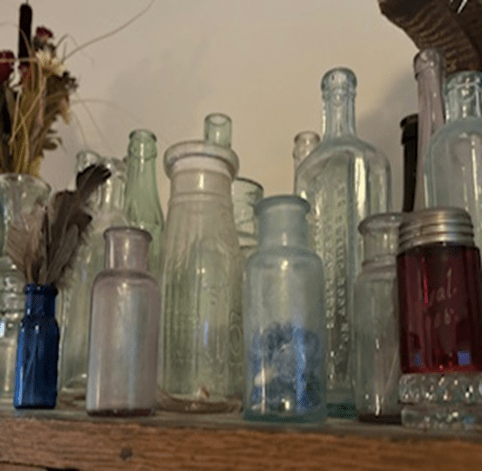
I’ve saved describing our bottle phase for last.
Bottles, old ones, have always felt like a link to history. Bottles made in molds, with company names, lined up on dealers’ tables, glinting in the sun fascinated us. They presented in a number of shapes and colors. Some were clear. Some, containing manganese oxide, turned light shades of purple with exposure to the sun. Noxzema blue was a popular color for collectors.
The bottles were mostly affordable, so that we often left with one small bottle as our treasure for the day. One Saturday it didn’t work out that way.
Maybe we were in a hurry, or maybe the dealer had a price just a bit too high. We looked at a bottle for a long time, admiring its unique shade of blue. Not the typical, popular dark blue. It was a shade lighter. After too little consideration, we put it down and moved on. On the way home, we talked about that blue bottle. The one we passed on. The next week we returned. By then, we felt that it—the blue bottle—was destined to be ours. We sought out the dealer, a regular, and searched his stock. No sight of our blue bottle. Oh, no! We had the opposite of buyer’s remorse; we had why didn’t we buy it remorse.
The funny thing is that of everything we have bought—rockers, trunks and other bottles—that little blue bottle has stayed with us over the years as a metaphor for living. When we have a decision to make, whether it’s to buy something or travel somewhere, and are hemming and hawing over it, one of us will inevitably ask, “Is this a blue bottle?” It helps us prioritize and put things into perspective.
Lately when I feel overwhelmed by too much technology, I sit and lose myself in thought as light penetrates a row of old bottles displayed on the top of our oak Hoosier hutch. I look around my home and feel a bond with the furniture pieces we gave new life to. Nostalgia mixes with sadness. Our old flea market disappeared about twenty years ago. Times have changed. IKEA is all the rage. I see oak bureaus on street corners with Free signs on them. Television shows like Flea Market Flip encourage contestants to paint over beautiful old wood. Giving new life to old pieces has changed in a way I could never have foreseen. Watching, perched on our beautiful walnut rocker, I shake my head, cringe and shout at the eager young folk, “No, don’t do it. Don’t paint it!
Alas, the IKEA generation has other ideas. I hope they are left with a wealth of memories like those our furniture and flea market finds have given us. What is your blue bottle?
Copyright © 2024 by Gail Ouimet
 Walks Across
Brava! Well done! Susan
Sent from AT&T Yahoo Mail on Android
LikeLike